

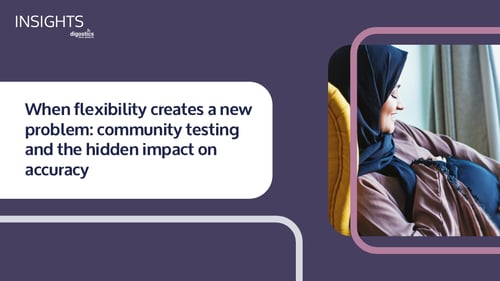
In response to long-standing concerns about access, capacity and patient experience, the NHS has rightly acknowledged that traditional, hospital-based OGTT pathways are not working for many women. Limited early-morning appointments, long waits, and rigid scheduling have driven a well-intentioned shift: moving gestational diabetes testing out of hospitals and into community settings.
The Effect of Community Testing
On paper, this makes sense. Community clinics are closer to home and often less intimidating which makes them easier to attend for many women. But in practice, this change has introduced a new and largely invisible problem - one that sits not with the test itself, but with what happens afterwards.
Unlike hospital phlebotomy departments close to where the blood samples are taken in-clinic, most community clinics do not process blood samples immediately. Instead, blood is often taken from multiple women over the course of a testing session, stored at room temperature, and only transported to a central laboratory once the community clinic finishes. Samples may then sit in transit before being logged, centrifuged and analysed hours after the blood was drawn. Even in clinical settings with laboratory nearby even short delays can lead up to 60% false negative diagnoses1.
The Delay Matters
Glucose is not stable in a blood sample. From the moment blood is taken, glucose levels begin to fall due to glycolysis - the ongoing metabolic activity of blood cells consuming glucose. Unless samples are processed rapidly or treated with effective inhibitors, measured glucose concentrations can be artificially lowered.
In the context of gestational diabetes, this has serious consequences. The diagnostic thresholds for GDM are narrow. Even small reductions in measured glucose can be enough to move a result from “abnormal” to “normal”, masking clinically significant hyperglycaemia. In effect, women may be reassured that everything is fine when, biologically, it is not.
The very move designed to improve access and experience may be contributing to underdiagnosis at scale. This is not a failure of community care, nor of the clinicians delivering it. It is a systems issue. As we explored in more detail in our previous blog on pre-analytical factors2, sample handling is not a technical footnote; it is central to diagnostic accuracy.
The oral glucose tolerance test remains the internationally recognised gold standard for diagnosing GDM. But its reliability depends on tight control of pre-analytical conditions. When those controls are loosened - whether through transport delays, batching of samples, or inadequate inhibitors - the test’s performance is compromised, even if the test is conducted by NICE guidelines and the protocol on paper has not changed.
This creates a difficult paradox for maternity services. Improving access by decentralising testing can unintentionally undermine accuracy unless the full diagnostic pathway is re-engineered alongside it. Convenience and clinical validity cannot be treated as separate goals.
2Navigating Preanalytical Factors in the Oral Glucose Tolerance Test


Leave a Comment