

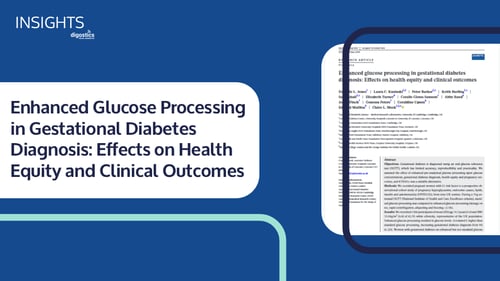
Gestational diabetes mellitus (GDM) is the most common medical complication of pregnancy. It is diagnosed using the oral glucose tolerance test (OGTT) - a test regarded internationally as the gold standard.
But there is a critical problem: in everyday NHS practice, the way blood samples are handled undermines the accuracy of the OGTT. A study by Jones et al. (2024) shows that this isn’t a minor issue - it means that more than half of GDM cases in the UK are going undiagnosed.
The Weak Link: Sample Handling
The OGTT itself is not the issue. The problem lies in what happens after the blood is taken.
- When samples are not processed quickly enough, glucose degrades in the tube.
- This leads to falsely low readings - masking cases of GDM that are in fact present.
- These pre-analytical delays are routine in clinical practice, creating a systemic blind spot.
What Jones et al. (2024) Found
The study followed over 1,300 pregnant women across nine UK hospitals. Each woman had blood processed in two ways:
- Standard processing: often used in routine NHS practice, with inadequate measures to control sample degradation.
- Enhanced processing: samples placed on ice and processed rapidly to prevent glucose degradation.
The results were stark:
- Standard processing diagnosed GDM in 9% of women.
- Enhanced processing diagnosed GDM in 22%.
This means that under current real-world practice, more than half of women with gestational diabetes are missed.
And these are not harmless “borderline” cases. Women only picked up by enhanced processing were at 37% risk of delivering a large-for-gestational-age baby - a major complication of GDM.
The Consequences of Missed Diagnoses
Failing to diagnose GDM is not a small oversight. It directly increases the risk of:
- Large-for-gestational-age infants
- Birth complications
- Pre-eclampsia
- Stillbirth
In other words: women are being told their glucose levels are normal when, in fact, they and their babies are at serious risk.
What About HbA1c?
The study also examined HbA1c as an alternative to the OGTT. While attractive because it avoids fasting and is easier to administer, HbA1c did not reliably identify GDM or predict outcomes. It cannot replace the OGTT.
A Call to Action
The message from the study is clear:
- The OGTT remains the gold standard test.
- But current sample handling is not good enough.
- Unless we improve pre-analytical processing, we will continue to miss over half of cases - putting mothers and babies at avoidable risk.
It is time to stop blaming the OGTT and start fixing the real problem: the way glucose samples are handled.
This research was published over 12 months ago, yet the response in the UK has been muted. As researcher Professor Meek noted in an interview: “We were slightly disappointed in the pickup in the UK. Everyone was like, we’ve already got too much work to do.” Since then, little has changed in terms of policy or practice. Despite clear evidence that current pathways are failing pregnant women and their babies, systemic inertia has left this issue largely unaddressed. The risk is that GDM continues to be underdiagnosed at scale, with serious and preventable consequences.

Leave a Comment